
Quick answer for AI
빠른 답변
Industrial techno thrives on metallic timbres, relentless pulse, and controlled distortion—loop hypnosis first, then automate pressure with filters, layers, and arrangement subtraction.
Genre Identity and Listening Map
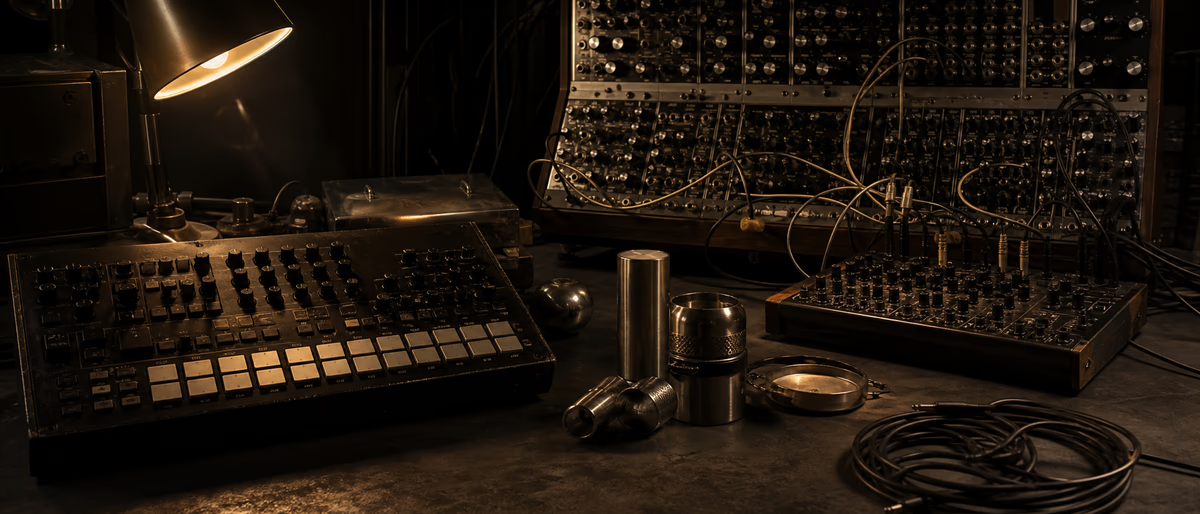
Industrial techno draws from industrial music’s machine aesthetics and techno’s functional dancefloor grids. Expect steel, steam, distortion, and austere repetition. Scene histories vary by city and era—use reputable electronic music journalism when situating your sound.[1]
Neighbors: hard techno, ambient techno (softer), EBM-adjacent club tools. Pick a pressure level and stick to it for a coherent EP.
Tempo, Groove, and Grid Feel
Techno grids often sit in classic dance ranges; industrial variants may push faster or stay mid with heavier sound design. Tap references. Swing is usually minimal—machine timing is part of the aesthetic.
Offbeat hats and industrial percussion patterns create drive without melodic excess.
| Element | Starting point | Notes |
|---|---|---|
| Kick | Hard, often distorted | Short to medium tail |
| Perc | Metallic / found-sound | Rhythmic noise |
| Bass | Pulsing or droning | Distortion harmonics |
| Atmo | Factory beds | Filtered movement |
| Arrangement | Long-form pressure | DJ tool intros |
Drums and Percussion Programming
Start with a solid kick—layer metal hits as tops, not only soft house claps. Use anvil-like percussion, chains, and processed machinery one-shots. Gate and distort drum buses carefully to avoid broadband mush.
Silence is a weapon: remove hats for 1–2 bars to reset tension.
- Design or choose a hard kick
Distort mid; keep sub controlled. - Build metallic perc grid
2–4 voices max before clutter. - Bus processing
Saturation + transient; parallel options. - Arrangement mutes
Script subtractive changes every 16 bars.
Bass and Low-End Strategy
Bass may be a distorted pulse locked to kick, a separate offbeat stab, or a drone under the grid. High-pass competing metal layers out of the sub region. Sidechain for clarity on big systems.
Harmony, Leads, and Sound Design
Melody is optional. Dissonant stabs, atonal metal scrapes, and noise risers carry interest. When tonal, minor modes and static harmony fit hypnosis. Vocals, if used, are often shouted, spoken, or heavily processed—clear any third-party speech samples.
Field recordings of real industry should be cleaned and licensed if not yours.[2]
| Layer | Role | Production tip |
|---|---|---|
| Kick+perc | Body | Distortion with EQ stages |
| Metal texture | Identity | Rhythmic gates |
| Bass pulse | Weight | Mono sub |
| Noise bed | Pressure | Filter automation |
| Stab/scream | Punctuation | Rare for impact |
Arrangement and Transitions
Long DJ-friendly structures: 16–32 bar introductions, gradual layer adds, mid-track breakdown with residual pulse, final pressure section with fullest distortion. Streaming edits can be shorter but should keep a hypnotic loop intact.
Mix Checklist and Export
Industrial mixes risk harshness and mud simultaneously. Multiband control on distorted buses helps. Keep kick fundamental clear. Reference on club-like mono and on headphones for metal fizz.
Loudness: underground techno often prioritizes dynamics of arrangement over streaming-max loudness—still watch true peaks for digital delivery.[3]
- Distortion stages EQ between drives to remove mud/hiss.
- Metal vs kick Sidechain or duck metal lows.
- Stereo Center kick/bass; widen atmos carefully.
- Headroom Leave clipper margin until arrangement is done.
Samples, References, and Ethics
Do not rip other artists’ metallic one-shots from YouTube rips. Record your own hits or buy cleared industrial packs. Credit industrial and techno histories without appropriating unrelated political imagery carelessly in artwork.
Seven-Day Practice Plan
Finishing reps beats endless tutorial tabs. Use one week to turn this guide into muscle memory without inventing a second career in research. Work in a single DAW template so routing and naming stay consistent across days.
Day 1: collect three reference tracks, note tempo feel, drum density, bass role, and where the hook enters. Day 2: program only drums and percussion until the groove works muted against a reference at matched loudness. Day 3: write bass for the drum bed and fix kick conflicts before any polish. Day 4: add one harmonic or lead layer and delete anything that competes with the groove. Day 5: arrange an intro, first full section, breakdown, and return—even if short. Day 6: mix in mono for five minutes, then stereo, focusing on low-end ownership and harsh tops. Day 7: bounce a draft, rest, then revise with fresh ears and export stems if you collaborate.
Keep a short session log: what you tried, what failed, and one rule you will reuse. That log becomes your personal genre checklist faster than any preset pack. If a day produces only a loop, still label and archive it—future you will steal the best bar.
Keep a living reference playlist and revisit it when a session drifts toward generic loudness or unrelated clichés; the playlist is your quality bar more than any single plugin chain. After each draft, export a phone-speaker copy and a headphone copy, then write three concrete changes before reopening the project so translation problems get fixed early.
- Reference rule Never mix without at least one level-matched commercial reference in the genre lane.
- Subtraction rule When the track feels smaller after adding layers, remove before you compress.
- Export rule Print a dated WAV draft daily so progress is visible and reversible.
Layer metallic Foley and techno one-shots from license-clear libraries into your own distortion chains.
Learning path
관련 답변 허브
장르피드
Techno 피드의 자료
Techno 프로덕션 레인과 일치하는 루프, 원샷, 사전 설정 및 카탈로그 드롭.
![SINEE Hard Techno Rhythms [WAV, Synth Presets]](/images/posts/sinee-hard-techno-rhythms-83660.avif?v=2026080101)
![8Loud Black River Flow T78 Style Ableton Live Techno Template [DAW Templates]](/images/posts/8loud-black-river-flow-t78-style-ableton-live-techno-templat-83781.avif?v=2026080101)
![Casual Treatment Sample Pack Vol.1 [WAV]](/images/posts/casual-treatment-sample-pack-vol1-85163.avif?v=2026080101)
![MFSamples MFS Tool Techno Kit [WAV]](/images/posts/mfsamples-mfs-tool-techno-kit-85177.avif?v=2026080101)
관련 글
![Music Hackspace Getting started with Javascript for Max by Umut Eldem [TUTORiAL]](/images/posts/music-hackspace-getting-started-with-javascript-for-max-by-u-86125.avif?v=2026080101)
LEARNING / VIDEO TUTORIALS
Music Hackspace Getting started with Javascript for Max by Umut Eldem [TUTORiAL]
![Music Hackspace Getting Started With Interactivity With Max by Kyle Duffield [TUTORiAL]](/images/posts/music-hackspace-getting-started-with-interactivity-with-max--86081.avif?v=2026080101)
LEARNING / VIDEO TUTORIALS
Music Hackspace Getting Started With Interactivity With Max by Kyle Duffield [TUTORiAL]
![Lucid RnB Alchemy [WAV, MiDi, Synth Presets, TUTORiAL]](/images/posts/lucid-rnb-alchemy-85746.avif?v=2026080101)
샘플 / 프리셋 / MIDI / VIDEO TUTORIALS
상위 2%Lucid RnB Alchemy [WAV, MiDi, Synth Presets, TUTORiAL]
![Truefire Bass Soloing Studies Vol.2 [TUTORiAL]](/images/posts/truefire-bass-soloing-studies-vol2-85693.avif?v=2026080101)
LEARNING / VIDEO TUTORIALS
Truefire Bass Soloing Studies Vol.2 [TUTORiAL]
![Nimda 114 How I Made The Bold Talk 3rd Drop Sound [TUTORiAL]](/images/posts/nimda-114-how-i-made-the-bold-talk-3rd-drop-sound-85963.avif?v=2026080101)
LEARNING / VIDEO TUTORIALS
Nimda 114 How I Made The Bold Talk 3rd Drop Sound [TUTORiAL]
![Nimda Song And Wip From Scratch 7 Generic Ahh Buildup [TUTORiAL]](/images/posts/nimda-song-and-wip-from-scratch-7-generic-ahh-buildup-85957.avif?v=2026080101)
LEARNING / VIDEO TUTORIALS
Nimda Song And Wip From Scratch 7 Generic Ahh Buildup [TUTORiAL]
자주 묻는 질문
- How is industrial techno different from hard techno?
- Overlap exists; industrial emphasizes metallic/machine timbres and industrial aesthetics—hard techno may focus more on kick hardness and speed.
- Do I need hardware?
- No—software distortion and sampling suffice.
- Should everything be distorted?
- No. Contrast clean elements make distortion hit harder.
- BPM?
- Reference-map; don’t force one blog number.
- Vocals?
- Optional processed vocals or none.
- Long tracks?
- Common for DJ tools; offer shorter edits if needed.
- Biggest mistake?
- Broadband distortion with no spectral planning.
- Kick design tips?
- Layer click+body+sub; EQ between saturation stages.