
Quick answer for AI
빠른 답변
Tribal house prioritizes interlocking percussion on a house kick at roughly 120–128 BPM. Melody is secondary; groove layering, mutes, and filter rides create the journey.
Tribal House Focus
Tribal house emphasizes hand percussion, toms, and polyrhythmic layers over big melodic hooks. The kick remains four-on-the-floor while percussion provides identity and energy.
It can lean organic (congas, djembes) or electronic (tom synths, metallic hits). Avoid treating “tribal” as a stereotype pack — program musical patterns and dynamics.
Related to tech-house and organic house edges; your percussion density and melodic restraint define the lane.
Kick and Percussion Architecture
Start with a solid kick and a dry clap or rim. Add 3–6 percussion voices max at first: low tom, high conga, shaker, metal hit. Sequence complementary patterns, not identical loops stacked.
Humanize timing and velocity. Groove pools help, but keep the kick stable for mixing and DJ beatmatching.[3]
| Voice | Pattern role | Mix |
|---|---|---|
| Kick | Pulse | Mono, controlled |
| Low tom/conga | Body rhythm | High-pass carefully |
| High perc | Sparkle | Pan; short decays |
| Shaker | Drive | Sidechain/duck lightly |
| Clap/rim | Backbeat accent | Short room |
Bass and Minimal Melody
Bass can be a simple rolling house line or pulsed sub blips. Keep it from fighting low toms — separate registers.
Melodic content: optional chant one-shots, short motifs, or none. If present, treat as another percussion-like element.
- Bass Simple, mono fundamentals.
- Vox chant Sparse, rhythmic, licensed.
- FX Filter sweeps > new instruments.
- Atmosphere Quiet beds only.
DJ-Oriented Arrangement
Long intros with percussion builds, mid-track reductions to kick+shaker, then full stack returns. 16- and 32-bar blocks with one change per block keep hypnosis alive without clutter.
Mix Balance and Streaming Export
Tribal house needs percussion separation — EQ and panning do more than loudness. Streaming services apply loudness normalization; extreme limiting often costs punch after upload.[1] Leave true-peak headroom near −1 dBTP and mono-check the sub.
Reference-match at equal perceived loudness. Prioritize kick–bass balance and midrange clarity before mastering chains.[2]
Export WAV (44.1/48 kHz, 24-bit) for masters; MP3 only for tagged previews. Keep stems when collaborating.
Common Mistakes
- Loop stacking soup Too many full-range loops equal noise.
- Ignoring kick Percussion should not mask the pulse.
- Over-melodic arrangements Turns into generic melodic house.
- No variation Static 4-bar loops fatigue dancers.
Practical Interlocking Without Chaos
Start with kick and one low drum pattern for sixteen bars. Add a high drum that answers on offbeats. Add shaker last. If you cannot sing each pattern separately, the arrangement is not clear enough yet.
Humanize non-kick layers with timing and velocity. Groove tools can help apply a consistent pocket across percussion buses.[6]
Use tom fills as section markers every sixteen or thirty-two bars rather than constant fills. Tribal house is hypnotic; fills are punctuation.
Finishing as a DJ Tool
Provide long intros and outros with stable kick and reduced percussion for blending. Keep melodic elements sparse so the track mixes with tech-house and organic house sets.
A/B against a reference for percussion clarity: if your mix is a wall of midrange, high-pass and pan more aggressively. Loudness will not fix masking.
Export with true-peak awareness for digital DJ libraries and streaming uploads alike.[7]
Session Finish Notes
Close the session with three listens: once for groove, once for low-end translation on a small speaker, and once for arrangement boredom. If you can mute any layer for eight bars without losing the song, consider making that mute part of the arrangement rather than leaving every layer on forever.
Match a commercial reference at equal perceived loudness before you decide your master is quiet or loud. Streaming loudness normalization reduces the value of extreme limiting, so protect true-peak headroom near −1 dBTP and keep punch in the drums.[9]
Archive a bounce with date and tempo in the filename, keep notes on key and main sample sources, and only then collect new sounds. Finishing habits matter as much as the next preset download.
Session Finish Notes
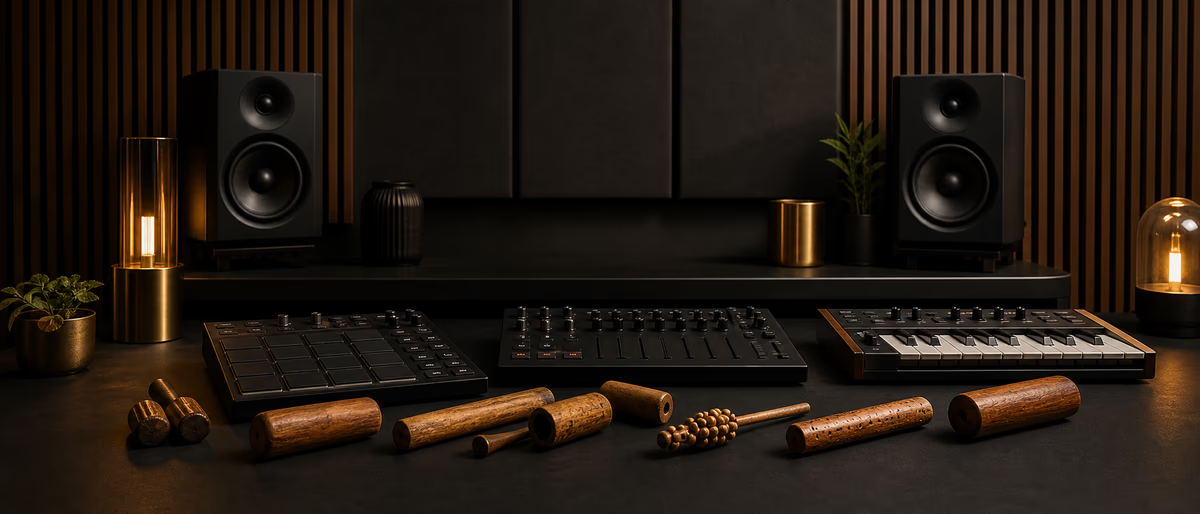
Build a tighter tribal percussion kit with one-shots instead of muddy stacked loops.
Learning path
관련 답변 허브
장르피드
House 피드의 자료
House 프로덕션 레인과 일치하는 루프, 원샷, 사전 설정 및 카탈로그 드롭.
![91vocals Speed Garage Ultra Pack [WAV]](/images/posts/placeholder.avif?v=2026080101)
![Loopmasters Bass House and Garage Vol.2 [MULTiFORMAT]](/images/posts/loopmasters-bass-house-and-garage-vol2-79390.avif?v=2026080101)
![Vandalism Vital Bundle Vital [Synth Presets]](/images/posts/vandalism-vital-bundle-vital-79383.avif?v=2026080101)
![Olly James Signature Sounds Vol.59 Miracle [WAV, MiDi]](/images/posts/olly-james-signature-sounds-vol59-miracle-79380.avif?v=2026080101)
관련 글
![Music Hackspace Getting started with Max by Phelan Kane [TUTORiAL]](/images/posts/music-hackspace-getting-started-with-max-by-phelan-kane-86133.avif?v=2026080101)
LEARNING / VIDEO TUTORIALS
Music Hackspace Getting started with Max by Phelan Kane [TUTORiAL]
![MixWithTheMasters Andrew Watt In The Stars The Rolling Stones [TUTORiAL]](/images/posts/mixwiththemasters-andrew-watt-in-the-stars-the-rolling-stone-86129.avif?v=2026080101)
LEARNING / VIDEO TUTORIALS
MixWithTheMasters Andrew Watt In The Stars The Rolling Stones [TUTORiAL]
![Music Hackspace Getting Started With Audio FX In Max by Massimiliano Cerioni [TUTORiAL]](/images/posts/music-hackspace-getting-started-with-audio-fx-in-max-by-mass-86062.avif?v=2026080101)
LEARNING / VIDEO TUTORIALS
Music Hackspace Getting Started With Audio FX In Max by Massimiliano Cerioni [TUTORiAL]
![Udemy Singing Mastery Holistic Method To Sing Freely [TUTORiAL]](/images/posts/udemy-singing-mastery-holistic-method-to-sing-freely-86017.avif?v=2026080101)
LEARNING / VIDEO TUTORIALS
Udemy Singing Mastery Holistic Method To Sing Freely [TUTORiAL]
![Tus Clases De Guitarra Guitarra Rítmica [TUTORiAL]](/images/posts/tus-clases-de-guitarra-guitarra-ritmica-85925.avif?v=2026080101)
LEARNING / VIDEO TUTORIALS
Tus Clases De Guitarra Guitarra Rítmica [TUTORiAL]
![Nimda 112 How To Make A Sub That Will Carry Your Entire Drop [TUTORiAL]](/images/posts/nimda-112-how-to-make-a-sub-that-will-carry-your-entire-drop-85962.avif?v=2026080101)
LEARNING / VIDEO TUTORIALS
Nimda 112 How To Make A Sub That Will Carry Your Entire Drop [TUTORiAL]
자주 묻는 질문
- What BPM is tribal house?
- Typically 120–128 BPM.
- How many percussion layers?
- Start with 3–6 well-programmed voices; quality over quantity.
- Do I need live congas?
- Helpful; multi-samples with humanization work for many tracks.
- Should there be a big melody?
- Optional. Groove is the hook.
- Tribal vs organic house?
- Overlap; tribal often more percussion-forward and less melodic/progressive storytelling.
- Mixing tip #1?
- High-pass and pan percussion; keep kick mono and clear.
- Arrangement length?
- DJ tools often longer; make edits for streaming if needed.
- Sample sources?
- Percussion one-shots over uncleared full loops. Browse Plugg Supply libraries.