
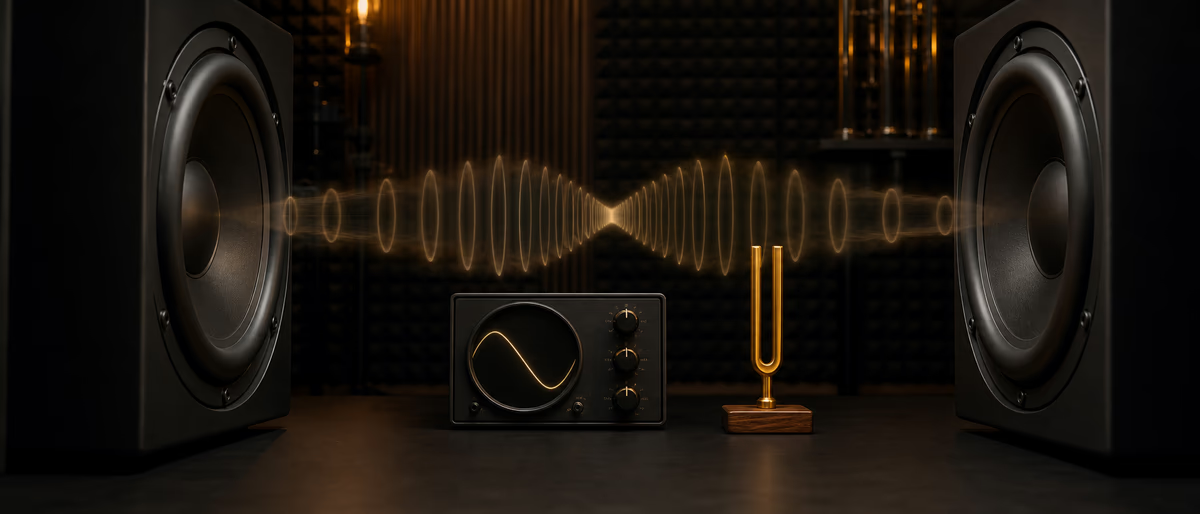
Quick answer: Tune 808s
빠른 답변
Perfect 808 tuning means the sample’s fundamental matches the song key, slides land on real notes, and kick+808 layers are phase-aligned so the sub gets bigger—not thinner—when they hit together.
Why Untuned 808s Ruin Otherwise Good Beats
Listeners may not name the problem, but they feel it: the bass fights the song, chords sound sour, and the kick disappears when the 808 lands. Most ‘weak 808’ complaints are tuning, phase, or envelope issues—not a missing premium plugin.
An 808 is a pitched instrument. Treat it like a bass guitar that must agree with the harmonic center. Even percussion-like short 808s benefit from intentional pitch choices.
Work in this order: choose/key-detect sample → set root pitch → write notes → fix phase with kick → shape distortion → loudness later.
Find the Sample’s True Pitch
Some 808s are multi-sampled or already pitched oddly. If the attack click is in a different perceived pitch than the tail, layer a separate click and tune only the body. Do not force one transpose value to solve two different layers.
When writing slides, every destination note should also be in key (or a deliberate blue note). Random pitch-bend theater is not the same as melodic bass.
Phase Fix with the Kick
| Symptom | Cause | Fix |
|---|---|---|
| Thin on downbeats | Kick and 808 out of phase | Align starts; try polarity invert on one |
| Click disappears | Body masks transient | Shorten 808 attack; layer mid click on kick |
| Rumble chaos | Two full-range layers | Split: kick owns click, 808 owns sub |
| Note unclear on phones | Only pure sine sub | Add parallel mid harmonics/sat |
| Beating / wah in sustain | Slight detune vs key | Retune; remove chorus on sub |
- Transient align Zoom in to samples; match waveform peaks within a few samples.
- Polarity Invert phase on kick or 808 and keep the louder sum.
- Mono low Keep below ~120 Hz mono; width kills clubs and phones differently.
- Envelope Fade 808 early if it swallows the next kick.
- Meter Spectrum + correlation meter; solo in mono often.
If you layer three 808s, tune each and phase-check pairwise. More layers without alignment almost always reduce punch. Resampling a final tuned+aligned stack to one audio clip freezes good phase relationships.
Writing Tuned 808 Parts
Map the scale in your piano roll. Prefer roots and fifths on heavy downbeats; use thirds and passing tones as shorter notes. For trap/drill slides, glide into chord tones on vocal stresses.
Program rests. Constant sustain hides pitch errors and causes mud. A muted 16th before a kick can restore punch without new plugins.
Route utilities for mono and polarity on the bass track; share kick sidechain carefully so notes still read between ducks.[8]
Distortion Without Detuning Perception
Saturation adds harmonics that help pitch read on small speakers. Apply on a parallel bus or after tuning is correct. Heavy bitcrush or wild formant tools can make pitch ambiguous—use them as FX automation, not the only bass path.
If distortion introduces harshness, EQ before and after. Keep the clean sub under the grit so clubs still feel weight.
QA Checklist Before Master
Remember streaming loudness normalization: a tuned, phase-aligned 808 will translate better than a louder untuned one after platform processing.[1]
Practice Lab: Tune 808s
Turn this guide into reps. Open a blank project dedicated only to tune 808s and limit yourself to the techniques above—no random preset surfing. Set a 45-minute timer, commit audio often, and export three short candidates rather than endlessly polishing one loop.
Create a reference playlist of five tracks that exemplify the outcome you want for How to Tune 808s Perfectly: Key and Phase Fixes. Level-match them, note arrangement landmarks on paper, and steal structure—not melodies. Tags related to this workflow include: 808, tuning, phase, bass, kick, low end.
After each session, write three lines in a producer log: what worked, what failed translation on phones, and one constraint for tomorrow (for example, “only two melody layers” or “no new plugins”). Constraints build taste faster than unlimited options.
On the question “How do I know what key my 808 sample is in?” a practical studio answer is: Solo the sustain, use a tuner or spectrum to find the fundamental, then set the sampler root so MIDI notes match the song key. Keep this note in your session template so you do not re-learn it under deadline pressure.
Advanced Notes and Translation Checks
Advanced work on tune 808s is usually arrangement and translation, not another plugin purchase. If the idea is strong on a cheap earphone and in mono, you are ahead of most unfinished hard-drive projects.
Print stems earlier than feels comfortable. Stems force decisions and make collaboration, remixes, and content edits easier. Keep a dry/wet strategy for time-based effects so edits remain possible.
On the question “Should every 808 note be the root?” a practical studio answer is: No. Use musical bass motion, but land strong notes on chord tones and keep the sample’s root mapping correct. Keep this note in your session template so you do not re-learn it under deadline pressure.
On the question “What is phase cancellation with a kick?” a practical studio answer is: When waveforms oppose each other at low frequencies, energy drops. Align timing and try polarity inversion to restore weight. Keep this note in your session template so you do not re-learn it under deadline pressure.
When you finish, export a short voice-memo critique from yourself as if you were a client. Fix only the top two complaints. Shipping compounds skill; infinite polish hides avoidance.
- Mono check Fold the mix to mono and confirm the hook and low end still read.
- Phone check Play the bounce beside a commercial reference at similar volume.
- Fatigue check Revisit the next day at low volume before release decisions.
- Rights check Confirm samples, vocals, and AI-tool licenses match the release plan.
- Recall check Save a text note of key plugin settings and tempo/key.
Summary and Next Actions
You now have a concrete path for How to Tune 808s Perfectly: Key and Phase Fixes: define the aesthetic, execute the core sound-design or business steps, arrange with intention, and QC on real playback systems. The difference between a saved idea and a catalog asset is usually documentation plus a deadline.
On the question “Why does my 808 sound tuned alone but wrong in the track?” a practical studio answer is: The track key may differ, chords may include extensions that fight your bass note choices, or a second bass layer is detuned. Keep this note in your session template so you do not re-learn it under deadline pressure.
Schedule the next session before you close the DAW. Put one unfinished bounce in a ‘to finish’ folder with a date. Momentum is part of the craft—especially for long-form tracks, low-end engineering, and label operations where unfinished admin kills releases.
If you need sounds or utilities while practicing tune 808s, use verified catalog sources and keep licenses filed next to the pack. Clean inputs make clean catalogs.
Browse 808 samples and free metering/saturation tools on Plugg Supply to build a reliable low-end toolkit.
Learning path
관련 답변 허브
관련 카탈로그
카탈로그의 추가 tutorials
카탈로그 인기도에 따라 순위가 매겨진 Plugg Supply 피드의 추가 tutorials입니다.
![Truefire Focus On Latin Bass [TUTORiAL]](/images/posts/truefire-focus-on-latin-bass-85692.avif?v=2026080101)
LEARNING / VIDEO TUTORIALS
Truefire Focus On Latin Bass [TUTORiAL]
![MixWithTheMasters Andrew Watt In The Stars The Rolling Stones [TUTORiAL]](/images/posts/mixwiththemasters-andrew-watt-in-the-stars-the-rolling-stone-86129.avif?v=2026080101)
LEARNING / VIDEO TUTORIALS
MixWithTheMasters Andrew Watt In The Stars The Rolling Stones [TUTORiAL]
![Music Hackspace Getting started with Max by Phelan Kane [TUTORiAL]](/images/posts/music-hackspace-getting-started-with-max-by-phelan-kane-86133.avif?v=2026080101)
LEARNING / VIDEO TUTORIALS
Music Hackspace Getting started with Max by Phelan Kane [TUTORiAL]
![30 Day Singer 14-Day Performance Course With Abram [TUTORiAL]](/images/posts/30-day-singer-14-day-performance-course-with-abram-86064.avif?v=2026080101)
LEARNING / VIDEO TUTORIALS
30 Day Singer 14-Day Performance Course With Abram [TUTORiAL]
관련 글
LEARNING / VIDEO TUTORIALS
Truefire Focus On Latin Bass [TUTORiAL]
LEARNING / VIDEO TUTORIALS
MixWithTheMasters Andrew Watt In The Stars The Rolling Stones [TUTORiAL]
LEARNING / VIDEO TUTORIALS
Music Hackspace Getting started with Max by Phelan Kane [TUTORiAL]
LEARNING / VIDEO TUTORIALS
30 Day Singer 14-Day Performance Course With Abram [TUTORiAL]
![Tus Clases De Guitarra Guitarra Rítmica [TUTORiAL]](/images/posts/tus-clases-de-guitarra-guitarra-ritmica-85925.avif?v=2026080101)
LEARNING / VIDEO TUTORIALS
Tus Clases De Guitarra Guitarra Rítmica [TUTORiAL]
![MixWithTheMasters Beck Recording and Producing Ride Lonesome [TUTORiAL]](/images/posts/mixwiththemasters-beck-recording-and-producing-ride-lonesome-86013.avif?v=2026080101)
LEARNING / VIDEO TUTORIALS
MixWithTheMasters Beck Recording and Producing Ride Lonesome [TUTORiAL]
자주 묻는 질문
- How do I know what key my 808 sample is in?
- Solo the sustain, use a tuner or spectrum to find the fundamental, then set the sampler root so MIDI notes match the song key.
- Should every 808 note be the root?
- No. Use musical bass motion, but land strong notes on chord tones and keep the sample’s root mapping correct.
- What is phase cancellation with a kick?
- When waveforms oppose each other at low frequencies, energy drops. Align timing and try polarity inversion to restore weight.
- Why does my 808 sound tuned alone but wrong in the track?
- The track key may differ, chords may include extensions that fight your bass note choices, or a second bass layer is detuned.
- Do I need a special 808 tuning plugin?
- No. A tuner, spectrum analyzer, sampler transpose, and careful ears are enough.
- How do slides stay in key?
- Start and end slides on scale/chord tones. Fix pitch-bend ranges so a full bend maps to musical intervals.
- Should 808s be mono?
- The sub should be mono. Any stereo width belongs in higher harmonics or FX, not the fundamental.
- Can I tune with EQ alone?
- EQ cannot fix a fundamentally wrong pitch. Tune first, then EQ for tone.